


CS-Cart and Multi-Vendor 4.20.1: Collapsible Menu, PWA App, and llms.txt Support for AI
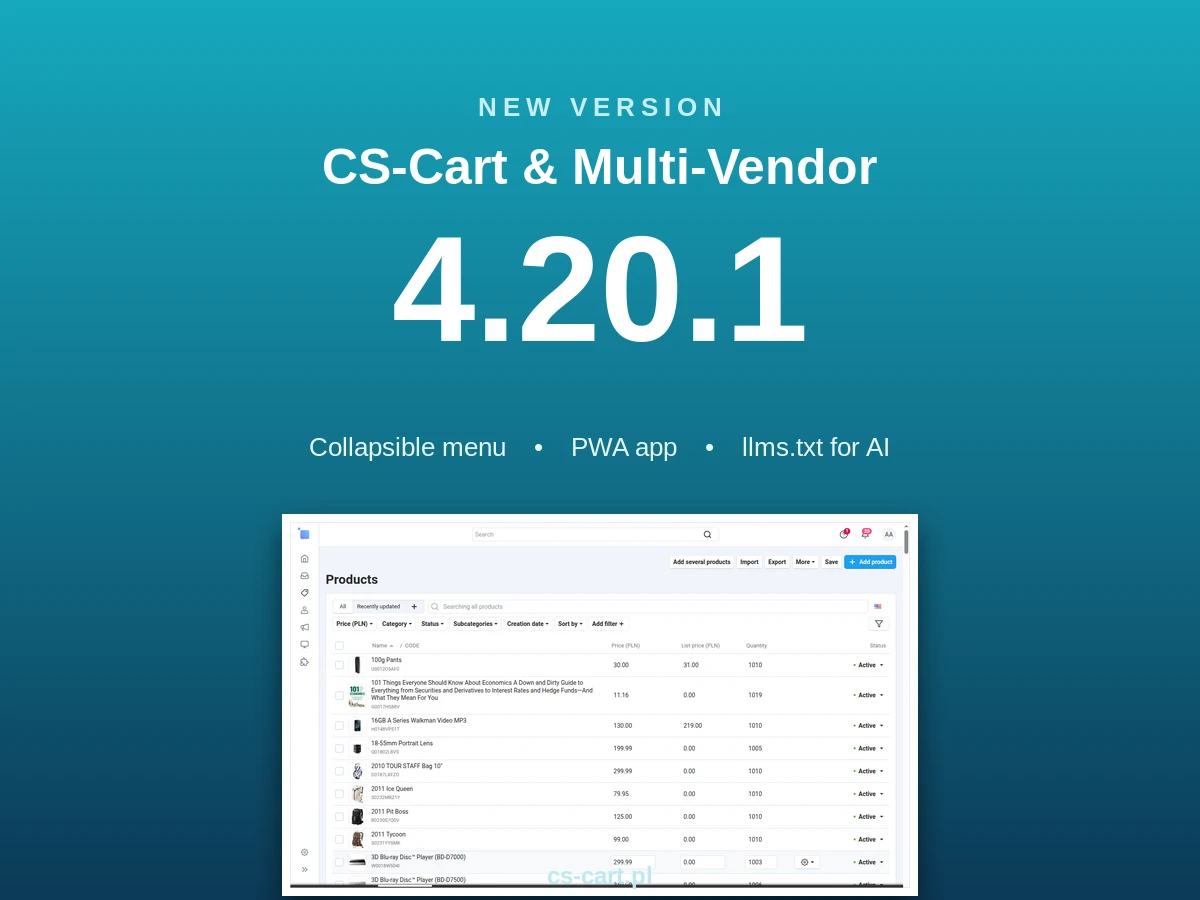
CS-Cart released version 4.20.1 for both CS-Cart and Multi-Vendor on February 24, 2026. This update focuses on three areas: more comfortable day-to-day work in the admin panel, modern shopping from mobile devices, and getting your store ready for the growing role of AI-assisted search. The headline changes are a collapsible admin menu, an optional Progressive Web App for every storefront, an llms.txt editor available straight from the panel, and, in Multi-Vendor, a significant expansion of PayPal availability for vendors. Below we walk through the changes that will affect your everyday work with the store the most.
Collapsible admin menu and smoother work on smaller screens
The left-hand admin menu can now be collapsed into a slim icon bar. In the collapsed mode, navigation turns into dropdown lists, so you still get instant access to every section while freeing up noticeably more room for the workspace itself. You have two menu modes available and can switch between them at any moment.


Once the menu is collapsed, you simply hover over an icon to reveal the list of subpages for that section. The whole process happens without a page reload, so moving between sections stays fast.

Alongside this, the panel now behaves better on smaller screens and when you work in two windows side by side. The window can be made narrower than before until product or order lists switch to the mobile view. The right-hand search panel is now more compact and can collapse on its own when space is needed, and the button to reopen it is easier to spot. A 404 error that appeared when moving from the storefront to the admin via the bottom panel has also been fixed.
PWA, a way to turn your store into a mobile app
Starting with version 4.20.1 there is a new add-on that lets you set up a Progressive Web App for each of your storefronts. A PWA is, in practice, a website that looks, feels, and works like a mobile application: it has its own icon on the phone's home screen and supports badges and shortcuts. Customers install it directly from the browser, with no publishing in app stores and no separate development project.
The PWA runs on your existing theme and modules, so most changes to the look and features of your site automatically carry over to the app experience. It complements rather than replaces native mobile apps and is a faster, lower-cost route to an app version for businesses that value a quick launch.

The setup is simple. You set the app status, its name as customers will see it on their device, and a square icon (512 by 512 pixels is recommended), and all of it can be configured separately for each storefront. The add-on is available in Store Builder Ultimate and higher, and in Multi-Vendor Plus and higher.
llms.txt support and readiness for AI-assisted search
AI systems approach content differently from traditional search engines. Instead of simply indexing every page, they try to understand which materials on a site are truly important and what they are about. That is why SEO specialists increasingly recommend using an llms.txt file, a short index of the most important pages that helps AI models analyze your store more efficiently.

In version 4.20.1 you edit llms.txt right from the panel, under Website, SEO. You do not need file access on the server, and in a multi-store project you can prepare different content for each storefront. CS-Cart suggests good practices along the way: do not dump the entire catalog and every page, but point to the most important content, such as delivery and payment terms, the return policy, key categories, and the automatically generated price list and sitemap. The suggested number of links is twenty to fifty, in Markdown format. The in-panel editor is available in Store Builder Ultimate and Multi-Vendor Plus and higher, while the llms.txt file itself can be used in any store by placing it in the site root.
Protection against accidental loss of product features
Routine catalog work can sometimes lead to unintended data loss. From version 4.20.1, CS-Cart warns you in advance when a planned action may remove product features, and explains what to do next. The warning appears, among others, when you move products to categories that do not have certain features, when you detach categories from a list of features still used by products, and when you add or remove features within feature groups. As a result, everyday catalog housekeeping no longer ends in the loss of previously entered data.
Multi-Vendor: wider PayPal Complete Payments availability
In Multi-Vendor, the list of countries where vendors can connect their own PayPal accounts through PayPal Complete Payments (Multiparty) has been significantly expanded. Previously the supported markets included Australia, Canada, France, Italy, Spain, the United Kingdom, and the United States. Now more markets have been added, including Poland, Germany, the Netherlands, Czechia, the Scandinavian countries, and many others. For Polish marketplace operators this means their vendors can use this method without extra workarounds.
Other changes and fixes
Release 4.20.1 also brings a range of smaller improvements and fixes worth knowing about:
- the maximum resolution of uploaded images is now capped at 6000 pixels, configurable in config.local.php,
- the TinyMCE content editor has been updated to version 8.1.2,
- visual refinements were made to the Nova theme based on user feedback,
- the users list loads faster, and search has been sped up by two to three times on average, and up to five times in extreme cases,
- in the Call Requests add-on the phone number is now clickable, and the buy-in-one-click button in the Nova theme has a new icon,
- core security was strengthened and many bugs were fixed, including Apple Pay and Google Pay button visibility, city selection in Yandex Maps, the display of ratings in reviews in the Nova theme, a 404 error of the admin toolbar when opening in a new tab, and profile field validation during checkout.
No posts found
Write a review